Less review.
Better litigation.

AI first-pass discovery review for litigation firms that compete on efficiency. OneAuris reads every page of a production, scores it for relevance, flags privilege, and hands your attorneys a clean, ordered file. The eight-hour doc review becomes a ten-minute one.

40-60%
Review time reduced by AI-Assisted first pass
Thomson Reuters 2024 litigation survey
$0
Per-seat licensing. Flat rate. Unlimited users, matters, and pages.
2-20
Attorneys per firm. The segment legacy tools priced out.

Three steps. No training set, no ramp.

From a new matter to a prioritized review set. No setup project, no training corpus.

01

Brief the case.

A twenty-minute intake tells OneAuris what the matter is about.

02

Upload the production.

Drop the documents and walk away. OneAuris reads, classifies, and scores every page.

03

Review the result.

Your team gets a prioritized, privilege-flagged review set instead of a raw pile.

Value on the first matter, not the tenth.

01

Briefed, not trained.

Most review tools need a thousand tagged documents before they earn their keep. OneAuris needs twenty minutes. You tell it what the case is about, and it reads every document through that lens.

02

Nothing slips through.

Every page gets a first pass. Anything the system is unsure about gets a second, closer look before it ever reaches an attorney. The target is zero missed relevant documents.

03

Privilege, flagged on sight.

Name your attorneys and firms once at intake. OneAuris flags every document that touches a privilege holder, so nothing privileged walks into a production.

04

Your records stay yours.

Every document runs through a zero-retention pipeline. The model reads it and keeps nothing. For a firm bound by confidentiality rules, that is the whole point.

Everything a litigation team needs. Nothing it doesn’t.

OneAuris is purpose-built for first-pass discovery review, from upload to production export, with attorney judgment at every step.

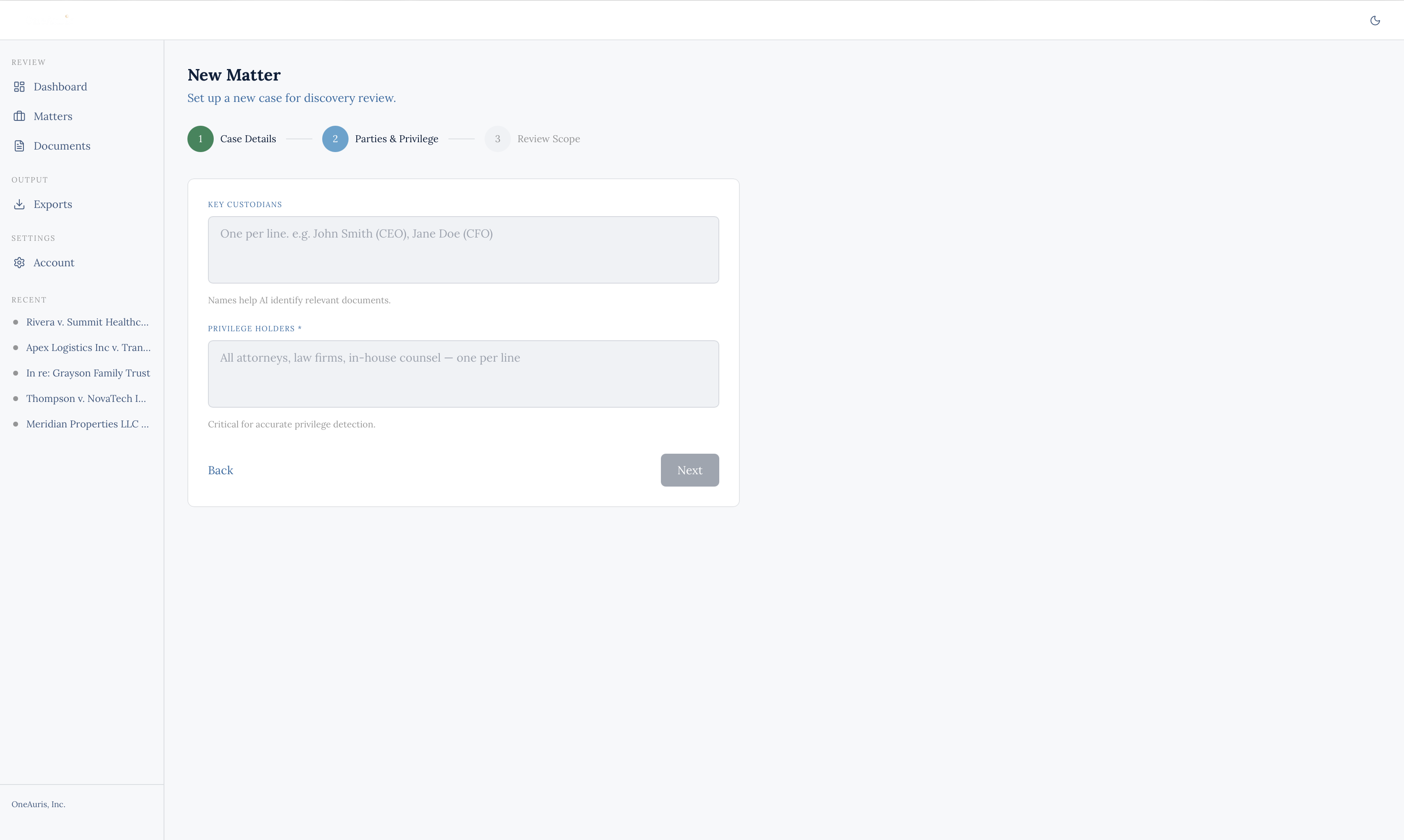
Brief the case in twenty minutes.

Before a document moves, you walk through a three-step setup: the parties, the custodians, the attorneys who carry privilege, the key terms, and the date range that defines the matter. That context is injected into every classification from that point forward. It is the difference between a tool that guesses and one that reads your case the way your associate would. It replaces the thousand-document training set a traditional tool demands.

Matter Intake

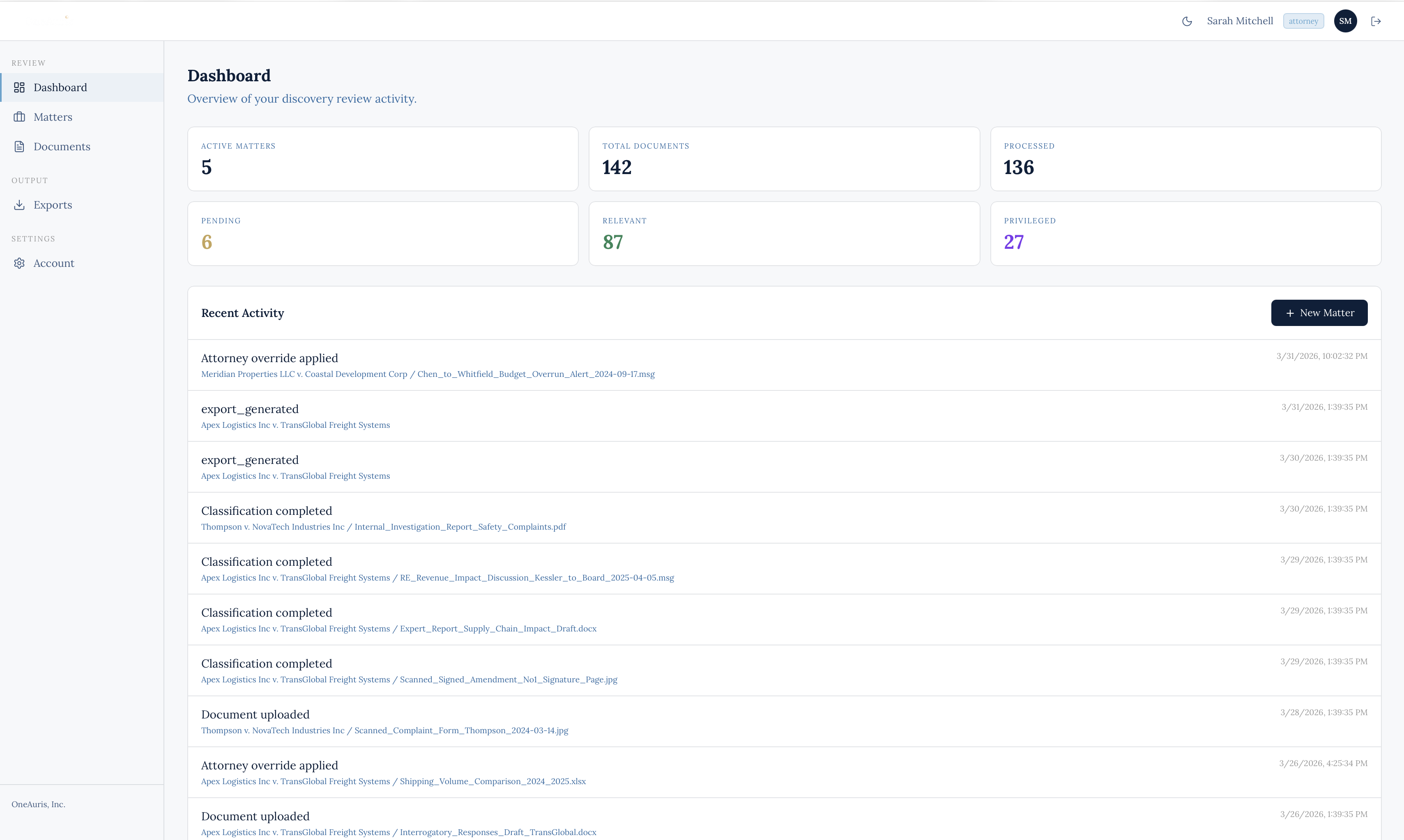
Where the case stands, in one look.

Every matter opens on a dashboard that answers one question: what is done and what still needs attention. Total documents, reviewed, outstanding, and privilege counts, all on the first screen. It’s the home base your team returns to between sessions.

Case Overview

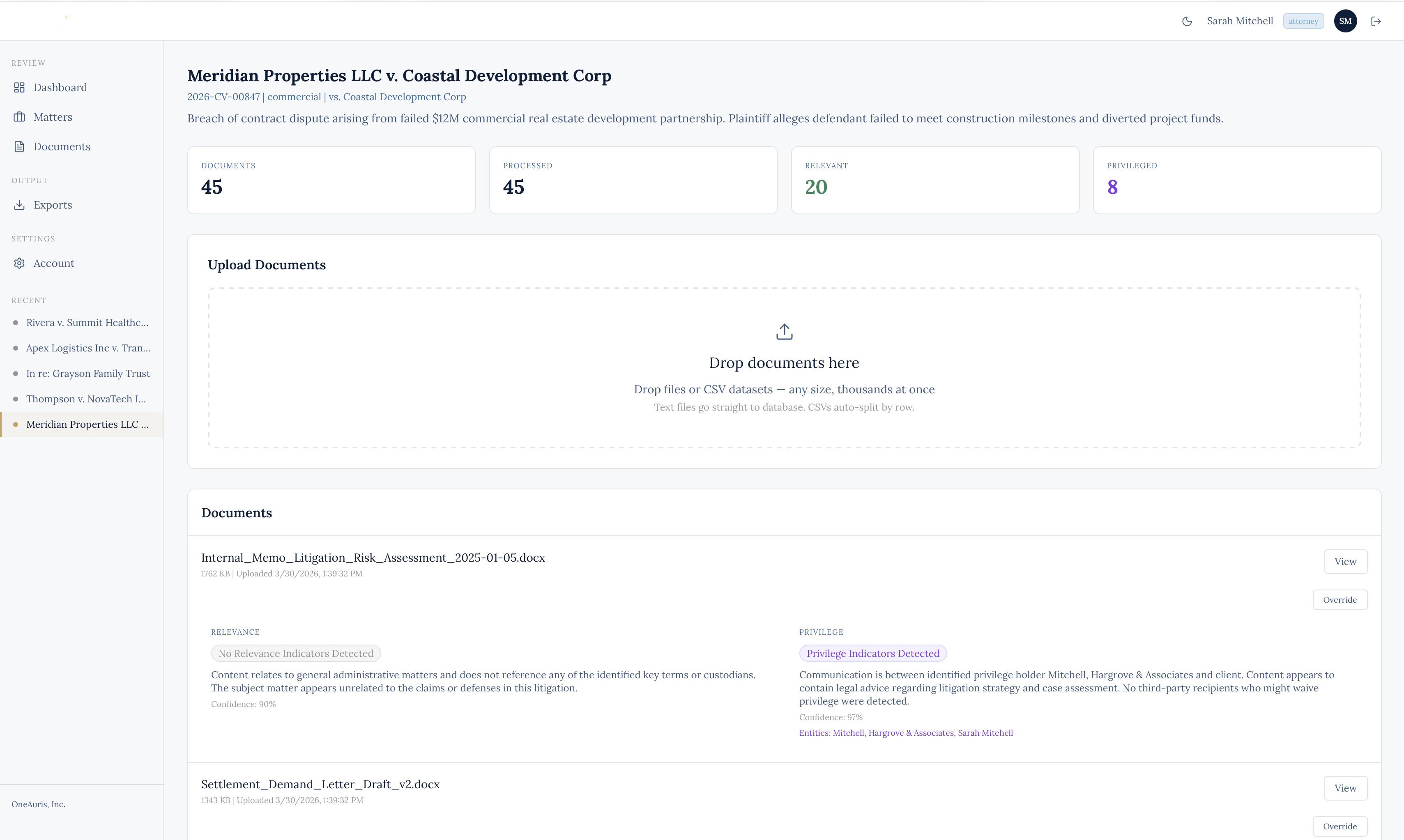
Every page read, scored, and flagged.

OneAuris reads each document page by page, classifies it by type, scores it for relevance to your matter, and flags it for attorney-client privilege. Uncertain pages escalate to a stronger pass before they reach an attorney. Your team reviews a decision, not a blank page.

Automated Review

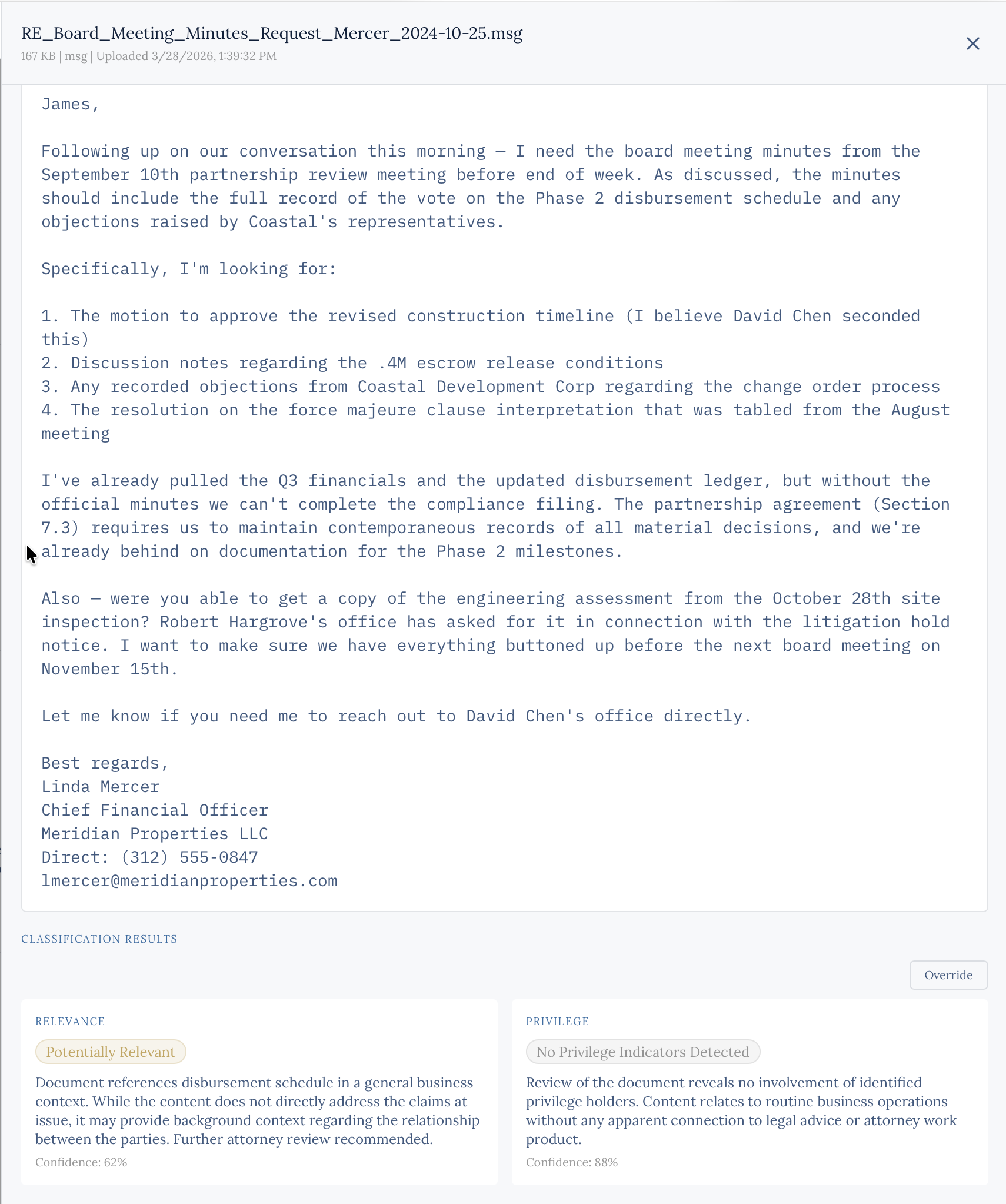
Read, confirm, or override.

Every document is a row you can sort by date, privilege, file name, or what still needs review, so the highest-priority work rises to the top. Click any row and the file renders full and readable, with its relevance score and privilege flag beside it. Agree with the call or overrule it in a click. Every override is recorded against the document. Pull two or more files side by side when you need to check a report against a bill or a record against its suspected duplicate.

Document Review

Eight hours of indexing, done in minutes.

Medical indexing is the workflow OneAuris was built for. OneAuris turns a stack of medical records into a clean index in reverse chronological order, built off the classification every page already carries. The junk never makes it in: fax cover sheets, blank pages, duplicates, proofs of service, billing, claim notes, and the rest of the exclusion list are ignored automatically. Before you export, you get a final pass to pull anything that slipped through. Every export writes an audit trail of exactly what went out.

Medical Indexing

The rest of what OneAuris does

Beyond first-pass review: the tools that carry a matter from intake all the way to production.

01

Upload

Drag in up to 100 documents at once, any file type, batches well past 50 MB. The upload returns immediately and processing runs in the background, with a live status on every file as it moves from queued to read to classified.

02

Duplicates

Click Find Duplicates and OneAuris greys out every copy it finds, with the option to delete. Duplicates drop out of the page count, so the number that drives your workload estimate and your billing conversation is the real one.

03

Document Sorting

Point OneAuris at a single combined file and hit Sort. It groups pages by document type and returns a set of separately named PDFs, one per type, as a zip with a manifest listing every file, its category, page range, and page count.

04

Timeline

OneAuris pulls dated events out of the documents and lays them out in order, so your team reads the story of the matter instead of reconstructing it. Filter the chronology down to what matters and jump straight to the underlying record.

05

Statement of Facts

OneAuris drafts a filing-ready statement of facts, each material fact stated and cited to the document it comes from, sequenced to line up with your argument. Facts and citations only. Export it as a PDF.

06

Witnesses & Key Custodians

OneAuris pulls every person tied to the matter out of the documents, witnesses and custodians alike, in one place. The people the case hinges on carry a Key Custodian badge. Click any name to jump to the records they held.

07

Mail Sorting

OneAuris reads incoming mail, identifies sender and recipient, writes a one-line subject, and drops it into the right person's inbox, grouped by sender, with a privilege badge on anything sensitive. It runs on its own, separate from your discovery documents.

Built for firms that cannot afford a leak.

Litigation data is sensitive by default. OneAuris is built to treat it that way.

HIPAA-Ready by Design

Workers' comp and PI files carry protected health information. OneAuris runs on infrastructure covered under a signed business associate agreement, encrypted in transit and at rest.

Zero Data Retention

Every document read runs through a pipeline where the model keeps nothing. Your records serve you, then they are gone.

Built to the SOC 2 Standard

Our controls follow the SOC 2 standard, with certification on the roadmap.

Privilege Protection Baked In

Privilege detection runs on every document and every piece of mail, keyed off the privilege holders you name at intake.

Set up around how your firm already works.

Show OneAuris one hand-sorted matter and it mirrors your categories from day one. That’s example-matching, not model training. Naming conventions, buckets, and exclusions follow what your firm already does. No workflow change, no thousand-document training set, no long ramp.

Flat-rate pricing. No surprises.

Monthly

$4,950 / month

Unlimited documents, matters, and users. Flat rate for your entire firm. No implementation fees, no per-seat pricing. Month to month. Cancel anytime.

Get started monthly
Save $9,900

Annual

$49,500 / year

Everything in the monthly plan, billed once a year. That's two months free versus paying month to month, the best rate we offer.

Get started annually

After payment, you'll create your firm's account.

Discovery review, sized for the firms doing the work.

OneAuris brings AI-assisted first-pass discovery review to the small and mid-size litigation firms that the legacy tools have priced out.

Discovery review is broken.

First-pass review is the most expensive, least leveraged part of litigation. Teams burn weeks of attorney and paralegal time reading documents that mostly don’t matter, just to find the handful that do.

The tools built to fix this were built for the largest firms. They are priced per seat, sold on annual contracts, and far too heavy for a team of two to twenty attorneys. So most firms still do it by hand.

AI-powered first-pass review at a price that makes sense.

OneAuris runs the first pass for you. Every document is reviewed for relevance and flagged for privilege, with the reasoning attached, so your team starts from a sorted, prioritized set instead of a pile.

Flat-rate, unlimited, no per-seat math. The technology that used to be reserved for the biggest firms, sized and priced for everyone else.

Give every litigation team a faster, fairer first pass.

The principles behind OneAuris

Zero false negatives

Missing a relevant or privileged document is the failure that matters most. We tune OneAuris to surface everything for review. Recall first, always.

Paralegal language only

OneAuris describes what a document is and why it matters. It never draws legal conclusions. That is the attorney's job, and we keep it that way.

Your data stays yours

Per-client isolation, US-only residency, zero AI data retention. Your documents are never used to train a model.

The team behind OneAuris

Alexander Tomalski

Co-Founder, Business Strategy & Operations

atomalski@oneauris.com

Constantinos Yiakas

Co-Founder, Head of Sales

cdyiakas@oneauris.com

Vir Sethi

Co-Founder, CTO & Product

vsethi@oneauris.com

Om Sethi

Founding Engineer

osethi@oneauris.com

Kevin Qu

Software Engineer

kevinqu@oneauris.com

Dev Pradeep

Software Engineer

devpradeep@oneauris.com

Frequently asked questions.

Everything attorneys ask before their first demo.

OneAuris handles the first pass through a discovery production. It reads every page, scores it for relevance to your matter, flags attorney-client privilege, and turns a stack of medical records into a clean, ordered index. Your attorneys review a prioritized set instead of a raw pile. It does one job well, not the full eDiscovery stack you will never use.
Privilege detection runs on every document, keyed off the attorneys and firms you name at intake. Anything the system is unsure about escalates for a closer look before it reaches you. No document is marked not-privileged with confidence when the text was too poor to read cleanly. Every classification carries an audit trail, and an attorney can override any call in one click. OneAuris does the first pass. Your attorneys still decide.
No. Every document runs through a zero-retention pipeline. The model reads it, returns a result, and keeps nothing. Your files are never used to train a model and never leave the infrastructure covered by our agreements.
Yes. OneAuris is built to HIPAA standards. Documents are processed with zero data retention under an executed BAA with our AI infrastructure provider, and we execute a BAA with each client firm before any PHI is uploaded.
About twenty minutes per matter. You walk through a short intake that tells OneAuris what the case is about: the parties, the custodians, the privilege holders, the key terms, and the date range. There is no thousand-document training set. You brief the case once and start uploading.
Litigation firms with two to twenty attorneys, built first for workers' compensation and personal injury defense. If your bottleneck is the hours spent sorting medical records and first-passing discovery, this is for you. If you are an AmLaw 200 firm running six-figure eDiscovery contracts, it is not.
$4,950 per month, flat, or $49,500 per year, which saves you $9,900 versus paying monthly. Either way that is the whole firm, unlimited matters, every feature included. No implementation fee, no annual maintenance, no per-gigabyte charges, no per-seat pricing. You know your cost before you ever talk to us.
No. Start with a free pilot on one of your own real matters. If it earns its place, you continue month to month. Nothing converts automatically and there is no long-term commitment.
Yes. We run a free pilot on a real matter of yours, usually a few hundred documents, so you judge OneAuris on your own work instead of a canned demo. If it does not help, you owe nothing and you keep the output.
No. It replaces the hours they spend on first-pass sorting and medical indexing, so they spend their time on the work that moves the case. Every decision is reviewable and every classification can be overridden. The attorney stays in control.
Up to 100 documents at a time, any common file type, with batches well past 50 MB. The upload returns immediately and processing runs in the background, with a live status on every file.
Those platforms are built for large firms and corporate legal teams, priced to match, and with capabilities most small firms don't need. OneAuris does one thing, first-pass review and medical indexing, at a flat price a small firm can plan around. Purpose-built for the firms the big platforms were never designed to serve.
Yes. Every classification is logged with its reasoning. Attorney overrides require a reason and are recorded against the document. Every export writes an audit trail of exactly what went out, so you can always show your work.
Request a demo. We walk you through it and set up a free pilot on one of your own matters.

See how much time you can recover.

Tell us about your discovery workflow and we’ll show you how OneAuris fits. 15 minutes, no pitch deck, no commitment.

New York, NY

Response time: within one business day